Offerings OneData Software Solutions
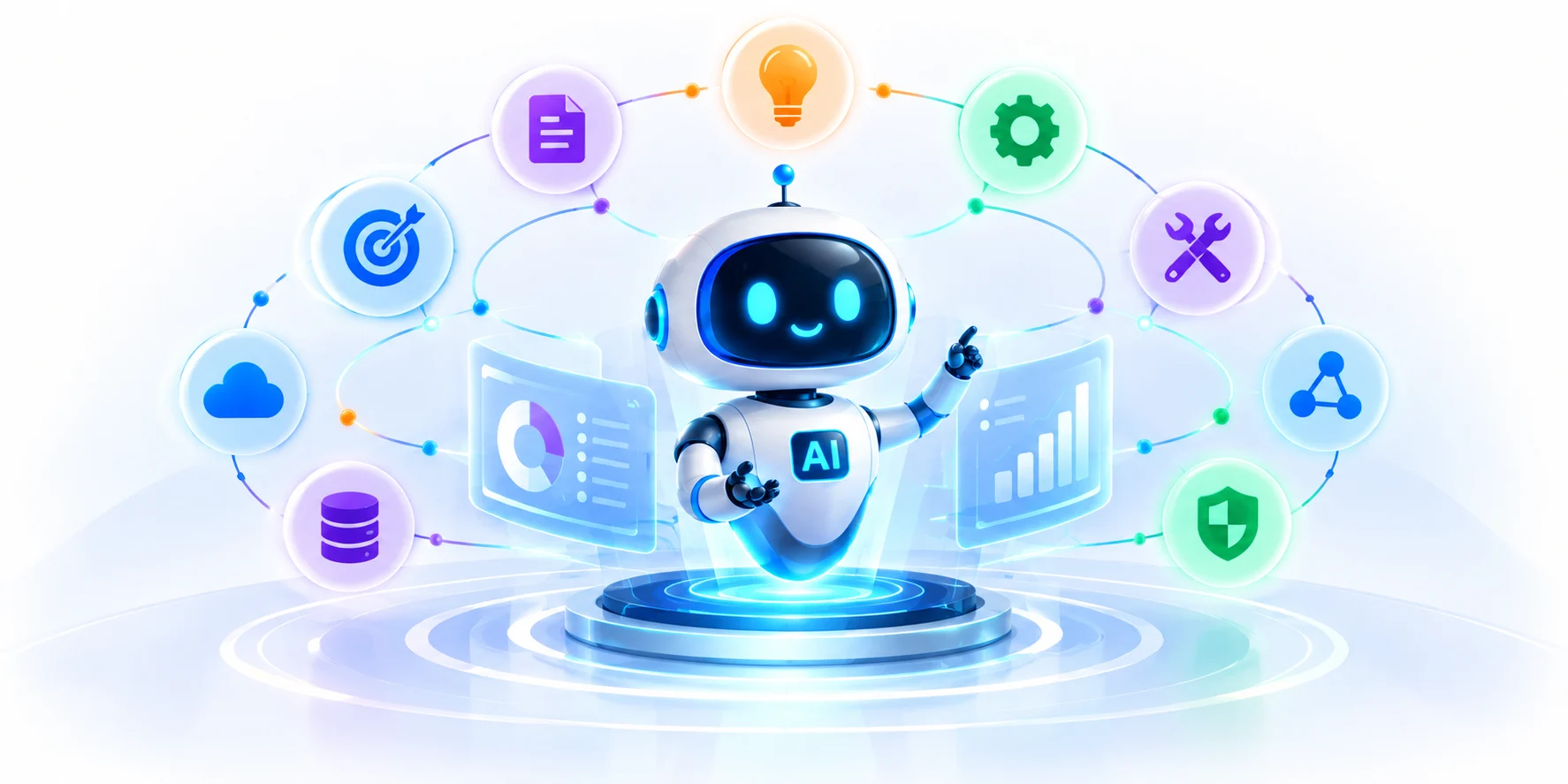
Artificial intelligence is moving beyond generating text, images, and answers. The next shift is toward AI systems that can understand objectives, make decisions, use tools, and act with limited human intervention.
These systems are commonly known as AI agents.
Unlike a traditional chatbot that primarily responds to a user’s prompt, an AI agent can work through a multi-step task. It can understand a goal, gather information, reason about the next step, interact with external systems, evaluate results, and continue working until the task is completed or human assistance is required.
This ability makes AI agents increasingly relevant to businesses looking to automate complex workflows, improve productivity, and build more intelligent digital experiences.
For organizations considering AI adoption, understanding how AI agents work—and where they can add value—is becoming increasingly important.
AI agents are not all built in the same way. Their capabilities depend on the task they are designed to perform, the level of autonomy they require, the tools they can access, and the environment in which they operate.
Simple reflex agents
Simple reflex agents operate according to predefined rules and the information available at a particular moment.
For example, a customer support system may identify a common request and provide a predefined response. These agents can be effective for repetitive and predictable processes but have limited ability to handle situations that require deeper reasoning.
Goal-based agents
Goal-based agents focus on achieving a particular objective rather than simply responding to an individual’s instructions.
For example, an agent could be given the goal of identifying problems within an application. It could analyze the application, identify potential issues, determine an appropriate solution, and work through multiple steps toward resolving the problem.
The user provides the objective while the agent determines some of the actions required to achieve it.
Utility-based agents
Utility-based agents evaluate possible actions according to specific objectives or desired outcomes.
For example, an AI agent managing cloud resources may need to balance performance, cost, availability, and resource utilization when determining what action to take.
This type of reasoning can be particularly useful when multiple possible solutions exist.
Learning agents
Learning agents can improve their behavior by using feedback, previous outcomes, or new information.
These capabilities can support applications such as personalization, recommendation systems, customer interactions, and business process optimization.
Multi-agent systems
Some business problems involve multiple specialized tasks that are difficult for a single agent to handle efficiently.
A multi-agent architecture can divide responsibilities among several agents. One agent could research information; another could analyze it, while another handles execution or validation.
This approach can be useful when businesses need to automate complex workflows involving multiple systems and decision points.
For businesses exploring Custom AI Agent Development, selecting the appropriate type of agent is an important starting point. The architecture should be based on the actual business problem rather than simply the capabilities of the underlying AI model.
The potential of AI agents is significant, but building an effective AI agent involves much more than connecting a large language model to an application.
One of the biggest challenges is reliability.
Traditional software typically follows explicitly defined instructions. AI agents, however, rely on AI models that can produce different outputs based on context and available information. This means developers need mechanisms to control, monitor, and validate agent behavior.
Another challenge is reasoning and decision making.
An agent may need to determine which tool to use, what information to retrieve, what action to take next, and whether the result is satisfactory. Errors at any stage can affect the outcome.
Tool integration is another important consideration.
Business AI agents may need to interact with CRMs, databases, APIs, enterprise applications, cloud services, communication platforms, or internal knowledge bases. Each integration introduces additional technical dependencies and potential points of failure.
Then comes security.
An AI agent with access to business systems can potentially perform actions rather than simply provide information. Therefore, organizations need appropriate authentication, authorization, access controls, data protection, monitoring, and safeguards around agent actions.
For example, an agent may be allowed to retrieve customer information but require human approval before modifying sensitive records.
Evaluation is another major challenge.
With a conventional application, developers can test whether a specific input produces an expected output. With an AI agent, evaluation may need to consider an entire workflow.
Did the agent understand the objective?
Did it select the right tools?
Did it use accurate information?
Did it complete the task?
Did it make unnecessary decisions?
Did it remain within its permissions?
These questions make testing and monitoring an important part of AI Agent Development Services.
The challenge is therefore not simply making an AI agent capable of taking action. It makes that agent reliable, secure, observable, and useful in a real business environment.
At OneData Software Solutions, we see AI agents as more than systems that generate responses.
The real value comes when an AI agent can understand a business objective, work with relevant information, interact with business systems, execute multiple steps, and contribute to an actual workflow.
Our approach starts with business problems rather than technology.
What is the business problem? → What decisions need to be made? → What information does the agent need? → Which systems should it interact with? → What actions can it safely perform? → Where should humans remain involved?
This workflow-first approach helps businesses identify where AI agents can genuinely add value.
For example, a company may want to automate customer interactions, streamline recruitment, improve sales processes, analyze business data, or coordinate internal operations. Each use case can require a different agent architecture, integrations, tools, and level of autonomy.
This is where Custom AI Agent Development becomes important.
Rather than implementing the same AI agent for every organization, businesses can build agents around their specific workflows, systems, data, and objectives.
OneData’s AI and cloud capabilities include working with AWS technologies and AI services to develop scalable solutions. Its published AI agent work includes applications involving workflow automation, data management, intelligent interactions, and enterprise systems.
A good example is HireOne, an AI-powered recruitment solution designed around candidate screening and interview workflows. Its architecture uses Amazon Bedrock Agents as an orchestration layer alongside AWS services for information retrieval, voice interactions, interview processing, and structured data storage.
The example demonstrates an important principle: an AI agent becomes significantly more useful when it has access to the right context, tools, and business processes.
OneData has also worked on OneConnect, an AI-enabled contact-center platform incorporating conversational AI, voice capabilities, real-time assistance, analytics, and communication channels.
These types of implementations demonstrate how Enterprise AI Agents can move beyond standalone chat interfaces and become part of broader business applications.
However, autonomy should also be introduced carefully.
Not every process needs a completely autonomous AI agent.
In some workflows, an agent can recommend an action while a human makes the final decision. In others, the agent can automatically handle routine activities while escalating unusual or sensitive situations to an employee.
This combination of automation and human oversight can help businesses introduce AI into critical workflows while maintaining appropriate control.
For enterprise environments, security, scalability, observability, governance, and integration should also be considered from the beginning.
An AI agent may interact with customer information, business data, internal applications, or operational systems. Its architecture therefore needs clearly defined permissions and boundaries around what the agent can access and what actions it can perform.
The objective of AI Agent Development Services should therefore not simply be to build an autonomous system.
It should be to build an AI solution that works reliably within the organization’s existing environment.
AI agents matter because they are changing how people interact with software.
For years, using software has generally meant learning how to operate the software: opening applications, finding the right features, entering information, configuring settings, and manually completing individual steps.
AI agents introduce different models.
Instead of telling software exactly how to complete every step, users can increasingly describe what they want to accomplish.
This creates opportunities across industries.
A marketing agent could analyze campaign information and prepare insights.
A customer service agent could retrieve relevant customer information and assist with issue resolution.
A software development agent could investigate a bug, make code changes, run tests, and prepare the work for review.
A business operations agent could connect different applications and coordinate repetitive processes that previously required employees to manually move information between systems.
For enterprises, the opportunity is not simply about adding another AI tool.
It is about connecting AI with real workflows, business data, applications, and decision-making processes.
That is why businesses exploring Enterprise AI Agents should look beyond the question, “What can AI generate?”
A more useful question is:
“What business process can AI understand, improve, and responsibly execute?”
The answer will be different for every organization.
Successful AI-agent implementation will depend on choosing the right use case, designing the right architecture, connecting the right tools and data, establishing appropriate controls, and continuously evaluating performance.
The future of AI agents is therefore not simply about making them more autonomous.
It is about making them more useful, reliable, secure, connected, and aligned with the way businesses actually operate.
For organizations considering AI adoption, Custom AI Agent Development can provide a path toward building solutions around specific business requirements rather than forcing existing processes into a generic AI application.
Ultimately, AI agents represent a shift from AI that simply answers questions to AI that can help accomplish goals.
And that shift could fundamentally change how businesses build, operate, and scale digital workflows.